122 West Scenic
 122 West Built circa1860
 This two-story, frame, gable-roofed, coastal cottage has a double-tiered inset gallery with giant-order square columns. It is considered a good example of this regional vernacular form. It has accordion-style upper-level banisters and is fronted by a cast-iron fence. It is a commercial residence which has operated under different names including the Evangeline.
Historic Note: This was the original building that made up the Crescent Hotel complex during the 1880s. One of the former owners was Andrew Stewart.
San Souci
Pass Christian
At the time that the San Souci Hotel was built, the other more prominent hotel was the Pass Christian Hotel, which had its origins of construction that appear to date back to the early 1830s. There was also the Mansion House that was probably built about the same time as the San Souci, in the 1850s. Pass Christian had developed into being one of the Watering Holes and Resort Spas along the Gulf coast bidding for weekend and summer vacationers from New Orleans, Baton Rouge, and Natchez. From the year 1848, when the town was chartered, a construction boom had begun taking place in Pass Christian as initiated by the promotions of John Henderson, Charles Shipman and David Hughs. —And continued through the end of the 1850s by John Henderson, Dr. William Calvert, Dr. William White, and Roger Hiern. —And further, during the Antebellum period, others began introducing their friends to development, speculation, and trading of viable sites for second home residences in order to escape the crowded, unsafe and often unhealthy conditions that existed in New Orleans.
 At Pass Christian, the first mainland lighthouse had been constructed on a high ridge near the center of town. The area that comprises the city’s commercial district today had become a most attractive real estate venture. It was owned by a freed Negro slave who died in 1835, leaving a very large tract of land to his Negro heirs. In those days, residential home sites weren’t lot size, or acre size – the sites were sold consisting of an arpent frontage on the Gulf and 40 arpents deep. This was roughly 200-feet wide by a mile deep.
 In 1849, and in 1850, for a total of $1000,William Keeland purchased two adjoining plots of ground that made up a 128-foot frontage on the Mississippi Sound ranging northward by a mile. This was located just a very short distance east of the Lighthouse in competition to the Pass Christian Hotel situated at the west side of the Light tower. Robert Montgomery had just taken over the older hotel where he promoted the first Sailing Regatta which was followed by the founding of the second Yacht Club in the United States – as it was formed in Pass Christian -- patterned after the one in New York City.
While Keeland was constructing his hotel, he leased the beach property south of the shell road on the high ridge. This shore to ridge property was known as Keeland’s Embankment. He leased one portion to Samuel Hooks who built a storehouse most likely for a retail enterprise. An adjoining portion he leased to A.G. Mallet for the construction of a commercial wharf where mail boats and schooners traversing the New Orleans to Mobile route could dock. Alighting passengers who were guests at Keeland’s hotel were free from charge. Keeland reserved the right to build a pavilion at the end of the wharf for hotel guests to swim, fish or go sailing. Mallet was permitted to build a billiard hall and saloon along side of the wharf landing at the shore. Mallet’s enterprise was evidently doing well because in 1851, he sold the balance of his 7-year lease to Jet Gammell for $1300 (considered a high money investment for those times).
The shell road, as it was often called, later took on the name of Main Street or Front Road, later Beach Road, then Front Street or Hwy 90, and more currently Scenic Drive, or Beach Boulevard – as called by Pass traditionalists.
Keeland also sold portions of his lands to the north – the first to Collom Ferry – adjoining the rear of the hotel. This was followed by a portion to Josephine and Charles Brevis and the larger most northern portion to William Ashley, a bachelor. A 12-foot public access alleyway along the eastern boundary of Keeland’s property line provided access to those properties where residences were built.
Apparently Keeland developed an illness, prior to his death which must have occurred in 1852 or during the early months of 1853. On May 24, 1853, the Widow Keeland sold the hotel for $8,700 to Mrs Aurelia Smith (later, Woodward) of West Feliciana Parish, Louisiana. The sale was subject to the lease previously awarded to Samuel Hooks for a store location, —and the wharf lease of Hooks and Phelps that had been transferred from Jet Gammell. The property description as sold contained 128 feet fronting on the Gulf reaching northward by approximately 1000 feet, with Mrs Collom Ferry on the north, Mrs Sarah Selph on the east, and the Bradley Children on the west.
" " "
The Widow Keeland, having four children and richer by the sale of the hotel, married William Ashley in the latter months of 1854. Ashley was one of the purchasers of Keeland property that was located north of the hotel and extended to Bayou Portage.
With the drums of war beating more and more loudly, the hotels in the area were feeling the loss of patronage. The Pass Christian Hotel closed down just prior to the opening of the Civil War. The Woodwards were evidently effected by the same financial woes. Of Mr and Mrs Woodward, Aurelia was probably the one with money, since it was she who had purchased the hotel from the Widow Keeland. Her money may have been inherited from a previous marriage, since she was first listed as Mrs Aurelia Smith.
 Later, the Woodwards evidently lost their property and hotel through a Sheriff’s sale, because in February 1859, Aurelia had to repurchase the property from John J McCaughan of Long Beach for $1100. This amount was considerably less than her initial investment and the true value of the hotel property.
 Aurelia was forced to sell a 41-foot beach lot for $1620 in monthly installments to William Manders in November 1860. This was followed by the very much larger northern portion (41-feet by one mile) being sold in March 1861, to Robert Cosbey for only $925.
In the mean time, Aurelia had become incumbent on a loan made with Elijah Cannon with whom she had also made a three-year rental lease of a 3-story dwelling at #15 Burgundy Street in New Orleans, both of which, she was in arrears. In April 1861, Aurelia rolled her indebtedness to Cannon with a mortgage loan of approximately $5000.
Gleaning from an August 2000, letter by Ella Prichard, great-great-granddaughter of Aurelia Woodward, she stated that Aurelia died in 1866, the same year that her daughter, Lucy Smith married AW Roberts of Lake Providence.
The Robert’s may have extended efforts to place their inheritance into good order but the property was once again forced to a Sheriff’s Sale by complainants William Roontz and wife in the amount of $5,928. 75. On February 20, 1871, at auction with a high bid of $1,250, Patrick Curtis acquired the former San Souci property It is not known whether Curtis tried to operate the hotel as a business or just leased it out. The fact that he was an active businessman, held public office as the Town Treasurer for many years and had his own residence and business establishment, it is more likely that he conducted the property as a commercial venture and may have operated the hotel in the name of Live Oak.
The South, Mississippi, the Gulf Coast, and Pass Christian were still in the throes of the Reconstruction Period as imposed by the Federal victors. It was two years later, in 1872, that the New Orleans – Mobile Railroad (now the L&N) was completed. This opened to the Coast comparatively inexpensive passenger service that extended an invitation to northern tourists to visit the remnants of a Dixieland under Reconstruction, or as Thaddeus Stevens referred to the South in 1865, the “conquered provinces.”
When “Carpet Bagger” rule ended and economic conditions were getting better, in January 1875, Patrick Curtis sold the hotel property to William Hart of New Orleans. A William Hart had been procuring property in the Pass since 1858. Later documents in 1891, show the “Estate of William. Hart” as owners of the Hotel Property (indicating his death). In “Along the Gulf,” Charles Dyer in 1895, describes William Hart as “a young gentleman who took charge of the (Crescent) house in 1888. Therefore, until further research reveals more, it may be assumed that this young Hart is the son of the original owner.
Further, it appears that the San Souci Hotel and the Crescent Hotel have some commonality. Additionally, the Crescent Hotel as described in 1895, consisted of two buildings, the larger of which was stated as being constructed in 1880, by Patrick Curtis.
Therefore, until further research is completed, several questions remain unanswered in determining which of the current properties in the one hundred block of West Scenic Drive would represent the site of Keeland’s original 128-foot Gulf frontage. However, it is safe to say that it lay between postal numbers 130 and 122 West Scenic Drive. Even though it would be presumed to be located at 122 and 126, this researcher would prefer to have more factual data before making that conclusion.
" " " " "
Research Statement: Further research on the Hart ownership of the Crescent Hotel needs to be completed as well as bringing current the western and eastern lots showing the ownership trail from the 1800s to current. Because of possible outer boundary changes with the adjoining properties to the Keeland/Woodward property, the evidence is not absolutely clear. Old deeds did not always remain fixed with surveys, nor were they frequently delineated by parallels and meridians. Most descriptions simply attempted to state the adjoining land owner by E,W,N and S. These descriptions did not always hold true. For this reason, the Keeland/Woodward property is left to “float” between postal numbers 130 West Scenic to 122 West Scenic Drive. However, by conjecture, the Crescent Hotel, aka Live Oak, aka San Souci, aka Keeland House, is more likely to be the existing building located at 122 W. Beach Boulevard.
Without having property abstracts to go by — all research has been performed solely by Dan Ellis. Anything to the contrary may be erroneous.
Dan Ellis
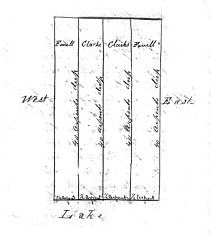
***Note: One of the very first purchasers of Pass Christian was Hewlitt. He acquired 2 arpents wide by 40 arpents deep that were situated 60' east of the Lighthouse and 30' west of the Charlot western boundary. (See DB 3-367 and DB 1-381) This was roughly 400 Gulf-front footage along the beach.